Wednesday, March 30, 2011

Grief and bipolar disorder

I lost a very close friend on December 20 and last spoke to him on his birthday on December 17. I got the email telling me of his death an hour after my child arrived for Christmas.

So I've not been much up to blogging. And even searches of research for how grief plays out in bipolar disorder were quite dissatisfying because basically whatever happens to everyone else happens to us but just more intensely.

What I know is that if it were not for friends I would not have lived through the last 3 months without hospitalization. I made it through teaching and being an economics student and just keeping my head above water. Daily emails from close friends got me out of bed in the morning and made me commit to my well-being. I avoided the psychiatrist and therapist because really I knew i needed more drugs and/or out of my house.

But I made it. I'm out of the tunnel and into a bit of a bright light but better hypomania than the darkness of depression.

This is a science blog and yet i'm not quoting science this post. What I am saying with resounding support from the literature is that having good friends is worth the effort. There is no pill for that. No therapy for that.

Tuesday, January 25, 2011

Brain flip-flop to pharma trip-hop

Ahhhh the sanity/pharma dilemma.

Do I beat back depression with Zyprexa and suffer nightmares and gain weight I don't want?

Do I suffer the desertification of my mouth from Lithium to keep my moods in check?

Do I beat resist being the living dead (i.e. insomniac from hell) with the zombiefication of Ambien?

Stay tuned for my next post later this week on the side effects game and what can be done about it.

In the meantime it's load up on the Omega-3, Vit Bs and Vit Ds.

If anyone can send me feedback on Biotene I'm really interested to hear what your experience has been.

Saturday, September 11, 2010

SO WHAT IF I’M CRAZY?

I am a strong African American woman: The kind that aced two challenging concurrent grad school programs while pregnant, spent years of duty as a single, professional mother thousands of miles from family, backpacked alone through Central America in my 40’s, soloed up 6000+ft mountains, worked as a social worker with challenging populations in Canada, the USA and the UK, rode the rapids of the White Nile in a tiny kayak and on a big rubber raft, got tenure, and started a highly successful maternal and child health project in Africa. I’ve earned a cape and a big ‘S’ on my chest.

I am an African American woman with a brain disorder – aka mental illness (specifically manic depression, also known as bipolar disorder). I have spent time in a mental health treatment facility, will probably need medication for a lifetime, and have spent many hours in a therapist’s office. I’ve got a whole professional team that works with me to keep me sane.

I used to be ashamed and secretive of the reality described in the previous paragraph but proud of the life described in the first. Now it’s an integrated whole. I know that taking off the cape and stripping my chest of the ‘S’ doesn’t make me any less of a strong African American woman. Superhero status is not required. I cannot save the world and sometimes I’m the one that needs saving.

Like many people I once felt that having a mental illness was a sign of personal weakness. As a mental health professional I spent lots of time convincing people otherwise, but when it was my turn I felt that going to the psychiatrist was a sign of failure. I tried running, acupuncture, yoga, Chinese herbs, meditation – anything but get ‘mainstream’ medical attention. I did not want to go to a psychiatrist because,“ Nothing is wrong with me. I’m not crazy!”.

I had no issue with going to the dentist, gynecologist, or orthopedist. Like many African Americans I stigmatized mental illness in a way we do not stigmatize obesity, diabetes, hypertension and so many other chronic and life-threatening illnesses. We will take pills to lose weight or lower our blood pressure but not to get or stay mentally well.

According to the mythology that surrounds the strength of African Americans, ‘falling apart’ is just not something we do. We survived the Middle Passage, slavery, racial oppression and economic deprivation. We know how to “handle our business”, “be a man”, or “be a woman”. We see therapy as the domain of ‘weak’, neurotic people who don’t know what ‘real problems’ are. Instead, to deal with our psychic pain we eat our way into life-threatening obesity, excessively use alcohol and drugs, and act-out violently through word and deed, but we do not go crazy.

Because being ‘crazy’ means you can’t handle life and in our story of who we are, we are survivors who can handle anything,; which means we do what we have to do to survive. But this does not usually include a trip to the mental health professional of our choice. It is time to add this to our survival toolkit.

Is it really better to be a drug addict, obese with high blood pressure and diabetes, or be verbally/physically/emotionally violent to those around us, instead of seeking help for that which troubles us so deeply that we choose to self-destruct - though perhaps not in the stereotypical idea of what suicide looks like to us? I don’t think so.

At some point we must stop worrying what other people are going to think and get about the business of getting well and moving forward with our lives.

So how do African Americans begin to eliminate the stigma of mental illness so that we can get the help we need sooner rather than later, and support those who need it?

1. Talk about it. Don’t whisper or gossip about it. Talk about it at the BBQ. From the pulpit. On TV. On the radio. With our doctors. With our loved ones. If we can talk about our ‘sugar’ and our ‘pressure’, then we should be willing to talk about our depression.
2. Support each other in getting help. We send friends to the doctor for the nagging back pain so send them to get relief from their mental and emotional pain too. And don’t forget to ask them how they are doing as time passes; they need friends more than you know.
3. Let us not stigmatize the brain. It is attached to the body so mental illness IS a physical illness, especially as chemical imbalances are at the root of their expression. Furthermore, the biochemical impacts of a brain disorder are felt throughout the whole body, not just in the brain.
4. Say, “This person HAS a mental illness”, NOT “This person IS mentally ill”. We do not say, “That person IS cancerous”. Words have power.
5. Acknowledge that those who survive a brain disorder are as much survivors as family and friends who survive life-threatening diseases. Understand that we work just as hard to stay sane as the addict does to stay sober. As cancer or addiction go into remission so too do brain disorders.
6. Support people who share their stories of brain disorders. It is time to show that the faces and lives of African Americans with a mental illness are not just the faces and lives of the homeless person talking to the unseen. It is my face and my life; and the faces and lives of so many other men and women like me.
7. Advocate for accessible and affordable, culturally appropriate mental health services.

“Coming out” requires courage. Like any other consciousness-raising process, a range of role models that represent a variety of experiences with mental illness will change perceptions. As a community we have lists of accomplished African Americans to inspire us in our various endeavors. We need a list of African Americans with mental illness who have survived and thrived.

No doubt due to the stigma, it was difficult to find names of well-known African Americans with a “‘confirmed“‘ history of mental illness – and this is no place for innuendo or rumor-mongering. So I will start this list with me: My name is Ruth White and I have manic depression. I am a mother, poet, researcher, writer, kayaker, hiker, traveler, professor, swimmer, and as sane and happy a person as you would ever want to meet. My brain disorder does not define who I am.

Thursday, September 9, 2010

Seasons, Climate and Bipolar Disorder

As fall approaches many people living with bipolar disorder find that the changes in light/dark influence their mood. So I reviewed the literature for a sample of studies on the topic. Not much has been written lately on the topic but there seems to be inconclusive evidence about the influence of seasons and climate on the moods of people living with bipolar disorder. For a small sample of the research in this area, see below:


Using observations were provided by patients from different geographic locations in North and South America, Europe and Australia a recent study conducted by numerous researchers around the world found no relationship between moods in people living with bipolar disorder and seasons, latitude or climate.

Bauer et al (2009). Relationship among latitude, climate, season and self-reported mood in bipolar disorder. Journal of Affective Disorders, Vol 116(1-2), pp. 152-157.


In a large study of lithium serum levels measured between January 1995 and July 2004 in 3 large teaching hospitals in the Netherlands, there was a significant difference found in average lithium serum levels across seasons, with summer being the highest and winter being the lowest. However, these differences were too small to impact the therapeutic impact of lithium. Temperature variations followed the same pattern.

Wilting et al. (2007). The impact of environmental temperature on lithium serum levels. Bipolar Disorders, Vol 9(6), pp. 603-608.


As part of the ongoing STEP-BD (Systematic Treatment Enhancement Program for Bipolar Disorder), there was a study of seasonal and regional effects on people living with Bipolar Disorder I and II. Results showed that study participants who lived in northern areas were more likely to be depressed. Bipolar II patients were more ill year-round than were patients with Bipolar I and had greater monthly fluctuations in illness rates that patients with Bipolar I.

Friedman et al. (2006). Seasonal changes in clinical status in bipolar disorder: A prospective study in 1000 STEP-BD patients. Acta Psychiatrica Scandinavica, Vol 113(6), pp. 510-517.

Wednesday, August 25, 2010

Bipolar Tweets

Follow along with me on Twitter for information, strategies, science and random bipolar stuff:

bipolar101tweet

Tuesday, August 17, 2010

What Works...

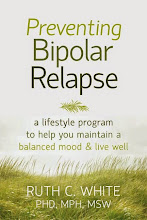
I have not updated this blog for more than a year because I wanted to take some time off from thinking about bipolar disorder after completing my book, Bipolar 101. Sometimes talking about bipolar disorder gets to be tedious and tiring but I know that the point of this blog is to take the 'relevant' science of bipolar disorder and make it accessible to a broad readership. I am thus back and ready to keep you current on information from science that you can use in your own life. Or at least, find it interesting.

This first entry of 2010 starts with a nice summary of what works in managing bipolar disorder. I have found all these strategies quite useful for myself and all of these are given full treatment in my book, Bipolar 101. Nice to know that taking these individual strategies which have been found useful are also useful in the aggregate.

Please read. Comment. And if you've read my book, please place a review online at Amazon.com or BN.com. Thank you.


A study of 32 high-functioning individuals diagnosed with bipolar disorder I and II found that the following self-management strategies were most effective in managing symptoms:
1. management of sleep, rest, exercise and diet;
2. ongoing monitoring;
3. enacting a plan;
4. reflective and meditative practices
5. understanding bipolar disorder and educating others;
6. connecting with others.
What works for people with bipolar disorder? Tips from the experts by Suto, M; Murray, G; Hale, S; Amari, E; & Michalak EE. (2010). Journal of Affective Disorders, Vol 124(1-2), pp. 76-84.

A review of the new diagnosis of Pediatric Bipolar Disorder suggests that the childhood characteristics of people who were diagnosed with classic Bipolar 1 symptoms are different than the characteristics of children now being diagnosed with Pediatric Bipolar Disorder. This suggests that perhaps many of the children now being given this diagnosis may grow out of their behaviors and may not meet the Bipolar diagnosis when they become adults.
Pediatric Bipolar Disorder: Part I-Is it related to classical bipolar disorder? by Littrell, J & Lyons, P (2010). Children and Youth Services Review, Vol 32(7), pp. 945-964.


ADHD in adults have different characteristics than ADHD in children and adolescents with less externalizing symptoms and more co-existing mental health disorders. People who simultaneously have ADHD and bipolar disorder have a more severe disease course, more severe mood disorder symptoms and lower scores on tests of functioning when compared to people who have only one of these disorders occurring at a time. ADHD symptoms are often diagnosed as part of bipolar disorder symptomatology and therefore people who have both disorders at the same time tend to be underdiagnosed and undertreated.
Adult ADHD and its comorbodities, with a focus on bipolar disorder by Klassen, LJ, Katzman, MA, & Chokka, P. (2010) Journal of Affective Disorders, Vol124(1-2), pp.1-8.

Thursday, April 9, 2009

Bipolar Research Update April 9, 2009

In a Swedish study of more than 9 million individuals, it was found that first degree relatives of people with bipolar disorder and schizophrenia were more likely to get these illnesses. Relatives of people with bipolar disorder were also more at risk of schizophrenia, including children adopted by a parent with bipolar disorder. Heritability for schizophrenia and bipolar disorder was 64% and 59% respectively.
Lichtenstein et al (2009). Common genetic determinants of schizophrenia and bipolar disorder among Swedish families: A population-based study. Lancet, 373(9659): 234-239.


In a family study there was no relationship between mood disorder in parents and personality traits in their children. Furthermore, parent's personality traits were not associated with risk of depression in their children.
Rothen et al. (2009). Personality traits in children of parents with unipolar and bipolar mood disorders. Journal of Affective Disorders, 113(1-2), 133-141

In a retrospective cohort study of more than 75,000 inmates in the largest prison system in the USA, it was found that inmates with serious mental illnesses, such as schizophrenia, bipolar disorder and major depressive disorder among others, were more likely to have had previous incarcerations. The greatest increase in risk of prior incarcerations were inmates with bipolar disorder who were 3.3 times as likely as inmates with no mental illness to have had 4 or more previous incarcerations in the 6 years prior to the study.
Baillargeon et al (2009). Psychiatric disorders and repeat incarcerations: The revolving prison door. American Journal of Psychiatry, 166(1), 103-109