Featured article:
Hirschfeld, R. M. (2014). Differential diagnosis of bipolar disorder and major depressive disorder. Journal of Affective Disorders, 169(S1), S12-S16.
Summary & Overview
In this article the author - a leading scholar of bipolar disorder - discusses the challenges of differentiating between bipolar disorder and major depressive disorder. Prevalence of unipolar depression is almost four times that of the range of bipolar disorders (including bipolar disorder I, bipolar disorder II and sub-threshold bipolar disorder).
The major challenge is that people with bipolar disorder tend to experience more depressive symptoms than symptoms of mania or hypomania and are much more likely to seek help when experiencing the lows of depression than when they are experiencing the highs of mania or hypomania. Several studies referenced in this article found that many people suffering from depression have undiagnosed bipolar disorder.
Therefore, if someone is seeking help for the first time it is important to differentiate between bipolar disorder and depression because anti-depressants alone are not helpful for people with bipolar disorder and are best used in combination with mood stabilizers; even then anti-depressants are not very effective. Furthermore, there is considerable debate about whether or not anti-depressants can cause destabilization or manic symptoms in people with bipolar disorder.
Symptomatic and Experiential Differences
The possible indicators of bipolar disorder in depressed patients include: earlier onset of symptoms, a family history of bipolar disorder, seasonality (with depression more likely in the winter months), mixed states, history of hospitalization, history of treatment-resistant depression, numerous past episodes, mood reactivity, switching on anti-depressants, more likely to experience psychosis and cognitive impairment, and are more likely to have a history of suicide attempts.
Screening and Diagnosis
The most popular screening tool for bipolar disorder is the 15-question Mood Disorder Questionnaire (MDQ) that takes approximately 5 minutes for the patient to complete. However, it is a screening tool and not a diagnostic instrument. The MDQ measures lifetime symptoms of hypomania and mania. It has been translated into 19 languages and has been cited in more than 600 publications. It correctly identifies 75% of people with bipolar disorder and screens out 90% of people without the illness.
The Hypomania/Mania Checklist (HCL-32) has 34 self-report questions that are completed in less than 10 minutes and assesses lifetime symptoms of mania and hypomania and will correctly identify 80% of patients with bipolar disorder and screen out 51% of people without the illness.
Another self-report instrument is the Patient Health Questionnaire (PHQ-9) which has 9 questions - that can be completed by the patient in less than 5 minutes - that assess current depressive symptoms. It correctly identifies 88% of cases of major depression and screens out 88% of people without symptoms. The author suggests that this is the best tool to measure depression among general patient populations because it is so short and so widely used.
The Beck Depression Inventory (BDI) is a widely-used 21-question (in the main version) instrument that screens for symptoms of depression and takes less than 10 minutes to complete.
The Inventory of Depressive Symptomology (IDS-SR) is a 30-item self-report questionnaire and the Quick Inventory of Depressive Symptomology (QIDS) is a 16-item version. Both instruments measure symptoms of depression and can be completed by a clinician or by the patient.
Included in this article is a table (Table 3) that compares all of the above instruments and 2 other clinician-rated scales. The Hamilton Depression Rating Scale (HAM-D) has 21 questions that are completed by a clinician and takes less than 20 minutes to administer. It assesses current depressive symptoms and has several different versions. The Montgomery-Asberg Depression Rating Scale (MADRS) is a 10-question scale that takes less than 10 minutes for a clinician to assess current depressive symptoms.
The PHQ-9, BDI, HAM-D and MADRS do not distinguish between bipolar and unipolar depressive symptoms.
Conclusion
Understanding the difference between instruments can help inform your discussion with clinicians about assessing symptoms and making the correct diagnosis.
Showing posts with label mania. Show all posts
Showing posts with label mania. Show all posts
Sunday, March 29, 2015


Sunday, March 2, 2014
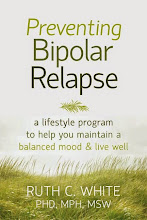
Preventing Bipolar Relapse: A Lifestyle Program to Help You Maintain a Balanced Mood and Live Well
Well....
All the writing about sleep, nutrition, exercise and interpersonal relationships has evolved into a program called SNAP (Sleep, Nutrition, Activity, People) and into a new book to be published in May by New Harbinger Press: Preventing Bipolar Relapse, that seeks to reduce the likelihood, frequency and intensity of bipolar episodes.
Click on the links below to order yours now:
Preventing Bipolar Relapse (New Harbinger Press)
Preventing Bipolar Relapse (Amazon)
From the publisher's website:
All the writing about sleep, nutrition, exercise and interpersonal relationships has evolved into a program called SNAP (Sleep, Nutrition, Activity, People) and into a new book to be published in May by New Harbinger Press: Preventing Bipolar Relapse, that seeks to reduce the likelihood, frequency and intensity of bipolar episodes.
Click on the links below to order yours now:
Preventing Bipolar Relapse (New Harbinger Press)
Preventing Bipolar Relapse (Amazon)
From the publisher's website:
"If you buy just one book on bipolar disorder, let this be it.
There's an old saying: “Prevention is better than cure.” If you have bipolar disorder, this is especially true. For you, it's incredibly important to read the warning signs of a possible episode. For instance, you may find you are not sleeping as well as usual, or you might be sleeping too much. You may stop doing things that you normally enjoy, or you may start acting out your impulses in ways that alienate those around you or get you into trouble.
While the path to wellness for those with bipolar may involve psychiatric visits and medication adjustments, preventing manic and depressive episodes is the true key to staying healthy and happy. So how do you do it? And most importantly, how can you keep yourself motivated?
In this powerful, breakthrough book, bipolar expert Ruth C. White shares her own personal approach to relapse prevention using the innovative program SNAP (Sleep, Nutrition, Activity, and People). White also offers practical tips and tracking tools you can use anytime, anywhere. By making necessary lifestyle adjustments, you can maintain balanced moods, recognize the warning signs of an oncoming episode, and make the necessary changes to reduce or prevent it.
This is the first and only book on bipolar disorder that focuses exclusively on prevention. To help you stay well, White includes links to helpful online tracking tools so that you can manage your symptoms, anytime, anywhere. If you are ready to stop living in fear of your next episode, this life-changing book can help you take charge of your diagnosis-and your life."
“Preventing Bipolar Relapse is an essential guide for the consumer and caregiver alike. White's SNAP approach gives the reader an easy method to successfully navigate the complexities of bipolar disorder. Her personal experience offers hope, encouragement, and the tools to prevent relapse.”
-Muffy Walker, MSN, MBA, founder and chairman of the board at the International Bipolar Foundation
-Muffy Walker, MSN, MBA, founder and chairman of the board at the International Bipolar Foundation
Tuesday, February 19, 2013
Scientific Update: Exercise, Mood, and Bipolar Disorder
Exercise is well-known to influence both physical and mental health. The articles reviewed in this post are specific to the impact of exercise on mental health and the symptoms of bipolar disorder. These articles show that people living with bipolar disorder are more likely to be overweight and to have poor eating habits. The implications of these studies is that people living with bipolar disorder must develop good eating habits and a routing habit of physical activity.

Objectives: There have been few comprehensive studies of nutrition and exercise behaviors among patients with bipolar disorder (BPD). Based on a national sample of patients receiving care in the Veterans Affairs (VA) health care system, we compared nutrition and exercise behaviors among individuals diagnosed with BPD, others diagnosed with schizophrenia, and others who did not receive diagnoses of serious mental illness (SMI). Methods: A cross-sectional study of patients who completed the VA's Large Health Survey of Veteran Enrollees section on health and nutrition in fiscal year (FY) 1999 and who either received a diagnosis of BPD (n = 2,032) or schizophrenia (n = 1,895), or were included in a random sample of non-SMI VA patients (n = 3,065). The groups were compared about nutrition and exercise behaviors Results: Patients with BPD were more likely to report poor exercise habits, including infrequent walking or strength exercises than those with no SMI. They were also more likely to self-report suboptimal eating behaviors, including having fewer than two daily meals.

Abstract: The aim of this study was to consider the effect of eight weeks of aerobic training on the reduction of mood disorders, depression and mania in boys' high school in Ilam-Iran. This was a quasi-experimental and field research taking the experimental and control groups into consideration. In this study, 60 students were randomly selected as the sample. In order to measure students' Depression and mania, multifaceted Minnesota questionnaire (MMPI-2) and depression and mania sub-scales were used. We applied both descriptive and inferential statistics using SPSS software for statistical analysis of data. The results showed that eight weeks of aerobic exercise had a significant effect on students` depressive disorders and mania. Eight weeks of aerobic exercise reduced depression and mania in experimental group of students. [Edited from the abstract written by the author]
Eriksson, Sebastian, and Gunvor Gard. 2011. "Physical exercise and depression." Physical Therapy Reviews 16, no. 4: 261-268.
 Objectives: The objective was to review studies which used physical exercise as an intervention to treat major depression, focusing on methodology, mechanisms of action, types of physical exercise and treatment outcomes. Methods: A literature review from PsycInfo and PubMed databases from 2000-2010 using the key words 'major depression', 'exercise', 'outcome', 'physical activity' and 'aerobic training' as search terms. Results: Eight studies met the inclusion criteria. Seven of the eight studies showed significantly improved mood and reduced depression. Three studies measured an increase in aerobic capacity, two with correlated mood improvements. One showed a correlation between increased muscle strength and reduced feelings of depression. Conclusion: Physical exercise can be an effective treatment against depression. A mood enhancing effect of exercise was identified in the interventions regardless of the mechanism of action. [Edited from the abstract from the author]
Thursday, June 7, 2012
HYPERGRAPHIA - the compulsion to write in bipolar disorder

It was not easy finding a 'reputable' definition of hypergraphia so I will accept the one from About.com as it is comprehensive and consistent with other definitions found in various more reputable sources.
A Definition
About.com definition (not the most scientific of sources):
Hypergraphia is a condition in which a person feels an overwhelming compulsion to write. People with bipolar disorder, especially during mania or hypomania, may find themselves writing for hours at a time, not necessarily realizing that this is unusual. It may take the form of journalling, creative writing, or copying page after page of a book. Hypergraphia may also be associated with temporal lobe epilepsy and schizophrenia, as well as certain brain injuries.
The Experience of Hypergraphia
I realized that my hypergraphia was associated with both hypomanic and depressive episodes but in different ways. When I am hypomanic I get creative and write all sorts of things - poetry, magazine articles, blogs, academic articles, abstracts, and long emails to friends. I also find myself entering notes into my blackberry, when I dont have access to paper or a computer. When depressed, I write dark poetry but have no other creative productivity. When I am hypomanic I have no desire to write poetry. My brain is just not so inspired. So in my search to understand this pattern, I found some interesting information I wanted to share with you and I would love to hear your stories.
What the Scientists Dont Say
It was not easy to find information on this condition. It did not show up in a search on the Merriam Webster online dictionary. A search on the website of the National Institutes of Mental Health (NIMH) and the Mayo Clinic also resulted in no entries. No books could be found in my school library database but In the PsycInfo and Medline databases it is primarily associated with temporal lobe epilepsy.
However there are some well known experts in psychiatry and neurology who have been writing about the behavior from personal and scientific perspectives.
What Some Scientists Say
The Midnight Disease - is a book by Alice Flaherty, a neurologist at Massachussetts General Hospital. She found herself writing compulsively both after the death of premature twin boys and the birth of healthy twin girls later diagnosed herself with hypergraphia. She believes that this behavior is attached to extreme moods that are found in people with manic depression and other people with brain disorders and brain injuries.

Dr Kay Jamison, a professor of psychiatry at John Hopkins University, was quoted in The Guardian (March 17, 2004) as saying that "Two aspects of thinking are pronounced in both creative and hypomanic thought: fluency, rapidity and flexibility ... and the ability to combine ideas or categories of thought in order to form new and original connections."
Mood Disorders and Creativity
In a conference at the Library of Congress (Depression and Creativity, Feb 3, 2009 - click link for video), both Dr Jamison, Dr. Whybrow discussed the controversial and long-standing (pre-Grecian) conversation about creativity and mood disorders. The symposium also included Dr. Terence Ketter who is chief of the Bipolar Disorders Clinic at Stanford University, whose research focuses on the relationship between creativity and madness. Though most artists and creatives do not suffer from mental illnesses but many creatives, especially poets, suffer a disproportionately high rate of mental illnesses, particularly depression and bipolar disorder. Dr Jamison refers to Mendelssohn, Virginia Woolf, Van Gogh as creatives with mood disorders. She argues that during periods of depression people are less productive and are more productive when they are manic or hypomanic.
The Advantages and Disadvantages of Hypergraphia
The Advantages and Disadvantages of Hypergraphia
The great thing about hypergraphia for an academic is the productivity. However it is frustrating that there are often so many ideas that cannot all come to fruition. It inspires insomnia. But the indulgence to these intense desire to write is that it compensates for depressive episodes where dark moods interfere with the discipline to complete ideas.
Manic depression has its advantages and disadvantages and though hypergraphia is both blessing and curse (depending on its expression), in a world where productivity is valued, I have no cause to resist its lure or try to medicate it away. There is beauty in seeing words that come from my brain. And one can only hope that others share the same view.
Note: This was written in a hypographic period during a hypomanic phase.
Saturday, November 12, 2011
Sleep: the secret to even moods

According to the National Institutes of Health, chronic sleep loss or sleep disorders may impact up to 70 million Americans and cost up to $16billion in healthcare costs and $60billion in lost productivity. So sleep is a big deal, not only to people living with bipolar disorder, who often have sleep disorders related to the illness
but also to people in general.
GOOD SLEEP is as essential for health as is good nutrition and physical activity. Getting good sleep means going to bed when you are tired, falling asleep within 15-30 minutes, staying asleep for 6-8 hours, and waking up feeling rested.
For manic episodes sleep goes bye bye and the rush of being able to just go-go-go eventually puts us in the hospital if we don't get back on track. During a bout of depression many people would prefer not to get out of bed. Treatment for bipolar disord

er usually gets people back on track with their sleep but if sleeplessness continues then they are often treated with medications that induce sleep.
Sleep deprivation (sleep deficit) is also the leading cause of accidents (of all kinds) in the USA because the brain does not function well on lack of sleep. Too little sleep also weakens our immune system so that we are more susceptible to illness. So what I am saying in this post can apply to anyone, not just people living with mental illness.
The latest research suggests that a sleep routine that keeps our circadian rhythms (internal clock) on a regular schedule, also keeps the mind on an even keel.
How do we do this? By developing a sleep routine; and at a minimum your sleep routine should include the following:
- Going to bed at the same time each night and getting up at the same time each morning. Everyday. No changes on weekends. This sets your internal time clock and helps keep your moods on an even keel.
- Give yourself 30 - 60 minutes to prepare for bed and find a way of developing a habit in terms of the sequencing of your preparation. The point is to slow down the body so it is ready to go to bed. For example, you could start by taking your medications (in particular, medications that make you drowsy) so they have some time to take effect before getting into bed? Or if they are quick acting you may want to take them last. Make sure you have set your alarm or put a glass of water by the bed (this is especially for people suffering from the dry mouth side effects of many bipolar medications). Some people find a bath calming. Others find a shower either calming or stimulating so find the activities that work best for you.
- A calming down activity such as meditation or yoga or reading (a calm book:). Drinking a cup of warm milk (which has naturally occurring ingredients that make people sleepy) or chamomile tea is also helpful.
Research has also shown that we sleep better in cool temperatures so make sure to turn off/down the heating in your room. A dark room also encourages sleep and if you cannot create a really dark room then sleep with a blindfold on. TVs should be banned from the bedroom. So should laptop computers and your cellphone, if you are having a hard time with distractions.
One of the best ways to get better sleep is to be physically active on a regular basis. For those who have trouble sleeping it is better if you exercise in the morning, because the body takes some time to calm down when you exercise so if you do it too close to your bedtime, your body may be to revved up to fall asleep.
If you want to know more about sleep and mental well-being and find evidence-based strategies for improving sleep, then check out a new publication by the Mental Health Foundation in the UK, which has published a free downloadable book on sleep called, 'Sleep Matters: The Impact of Sleep on Health and Well-Being', click here.
The National Institutes of Health also publishes a sleep guide called, 'Your Guide to Healthy Sleep' is available free if you click here.
Subscribe to:
Posts (Atom)


 Posts
Posts

