Monday, June 23, 2014

Social Support and Bipolar Disorder

The following is an excerpt from the book, Preventing Bipolar Relapse (New Harbinger, 2014)

Several studies have shown that social support from friends and family is important to preventing bipolar disorder. Studies seem to be biased towards the impact of social support on depression, probably because people with mania are less likely to seek help. The onset of symptoms can be accompanied by social behaviors such as irritability, anxiety and anger that impact social relationships and negative social relationships can exacerbate or trigger mood changes creating a downward spiral. Some studies of the link between social support and bipolar disorder is discussed below to demonstrate the evidence for making a case for seeking and maintaining a social support network that will improve your overall mental health and prevent and reduce the impact of symptoms of both mania and depression.

A study of social support and social strain (Eidelman et al, 2012) compared people living with bipolar disorder and people without a mental illness (control group) for 28 days using journals. The bipolar disorder group had lower measures of social support and more social strain that the control group. Manic and depressive symptoms in the bipolar disorder group were increased the more social strain they experienced. Social support was also associated with more stable sleep in people living with bipolar disorder.

Another study of social support and mood symptoms (Pratchett, 2010) among high-functioning people living with bipolar disorder showed that lower levels of perceived social social support was related to more severe symptoms of lower mood and higher mood, and to persistence of these symptoms 6 months later, regardless of age, marital status, income or gender.

Unsupportive social networks have also been found to increase the likelihood of medication non-adherence (Sajatovic et al., 2011). A study of unipolar and bipolar disorders found differences in the functioning of social networks between the two groups but found that stabilizing supportive relationships should be a goal of psychotherapy because both groups had minimal social networks and relied on one primary person for all their social support (Poradowska-Trosz, Dudek, Rogoz and Zieba, 2009).

Self-esteem has also been shown to be a mediating factor through which social support is expressed. This means that people with higher self-esteem are more likely to seek out social support and to have more friends. It also means that people with higher self-esteem are more open to the social support that a strong network of friends provide.


For adolescents with bipolar disorder it appears that family relationships are important to onset and continuation of symptoms (Sullivan et al, 2012). Family conflict, adaptability and lack of cohesion are predictors of adolescent mood symptoms. The authors suggest that family conflict be a focus of psychosocial intervention in early onset bipolar disorder.

REFERENCES
Eidelman, Polina, Anda Gershon, Katherine Kaplan, Eleanor McGlinchey, and Allison G Harvey, "Social support and social strain in inter-episode bipolar disorder." Bipolar Disorders 14 (2012): 628-640.
Poradowska-Trzos, Magdalena, Dominika Dudek, Monika Rogoż, and Andrzej ZiÄ™ba, "The comparison of social networks of patients with unipolar and bipolar affective disorder." Archives Of Psychiatry & Psychotherapy 11 (2009): 43-50. 
Pratchett, Laura.  "Social support in bipolar disorder: The relationship between social support and mood symptoms." US: ProQuest Information & Learning, 2010.
Sajatovic, M., M. Valenstein and F. Blow, “Treatment adherence with antipsychotic medications in bipolar disorder”, Bipolar Disorders 8 (2006): 232 – 241.
Sullivan, A. E., C. M. Judd, D. A. Axelson, and D. J. Miklowitz, “Family functioning and the course of adolescent bipolar disorder”, Behavior Therapy, 43 (2012): 837-847.

Tuesday, June 3, 2014

WEBINAR: SNAP: A simple 4-step plan for preventing bipolar relapse


On Wednesday, June 4 from 9-10am Pacific I lead a webinar on strategies that prevent bipolar relapse that are taken from my book, Preventing Bipolar Disorder (New Harbinger, 2014) and distilled into a 1-hour presentation. The webinar is sponsored by the International Bipolar Foundation and is titled: SNAP: A simple 4-step plan for preventing bipolar relapse. The science-based presentation focused on: good sleep hygiene, a healthy diet that includes good mood foods, a routine of physical activity, and the development and maintenance of a healthy support network.

To view/listen click here.


Thursday, May 1, 2014

NATIONAL MENTAL HEALTH AWARENESS MONTH 2014

Click this link to read the Presidential Proclamation of National Mental Health Awareness Month.

Take the time to make room in your life to do the things that promote mental well being. The four key paths are better sleep, good nutrition, regular exercise and healthy interpersonal relationships. If you have bipolar disorder, you may want to check out my books and learn more about the disorder and how to prevent and manage symptoms and promote a stable emotional and psychological state.

Also take time to participate in this month's events in your local area that promote increased access to services, the elimination of stigma and the increased knowledge and awareness of mental health.

Sunday, March 2, 2014

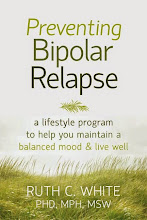
Preventing Bipolar Relapse: A Lifestyle Program to Help You Maintain a Balanced Mood and Live Well

Well....
All the writing about sleep, nutrition, exercise and interpersonal relationships has evolved into a program called SNAP (Sleep, Nutrition, Activity, People) and into a new book to be published in May by New Harbinger Press: Preventing Bipolar Relapse, that seeks to reduce the likelihood, frequency and intensity of bipolar episodes.

Click on the links below to order yours now:

Preventing Bipolar Relapse (New Harbinger Press)

Preventing Bipolar Relapse (Amazon)

From the publisher's website:

"If you buy just one book on bipolar disorder, let this be it.
There's an old saying: “Prevention is better than cure.” If you have bipolar disorder, this is especially true. For you, it's incredibly important to read the warning signs of a possible episode. For instance, you may find you are not sleeping as well as usual, or you might be sleeping too much. You may stop doing things that you normally enjoy, or you may start acting out your impulses in ways that alienate those around you or get you into trouble.
While the path to wellness for those with bipolar may involve psychiatric visits and medication adjustments, preventing manic and depressive episodes is the true key to staying healthy and happy. So how do you do it? And most importantly, how can you keep yourself motivated?
In this powerful, breakthrough book, bipolar expert Ruth C. White shares her own personal approach to relapse prevention using the innovative program SNAP (Sleep, Nutrition, Activity, and People). White also offers practical tips and tracking tools you can use anytime, anywhere. By making necessary lifestyle adjustments, you can maintain balanced moods, recognize the warning signs of an oncoming episode, and make the necessary changes to reduce or prevent it.
This is the first and only book on bipolar disorder that focuses exclusively on prevention. To help you stay well, White includes links to helpful online tracking tools so that you can manage your symptoms, anytime, anywhere. If you are ready to stop living in fear of your next episode, this life-changing book can help you take charge of your diagnosis-and your life."
Preventing Bipolar Relapse is an essential guide for the consumer and caregiver alike. White's SNAP approach gives the reader an easy method to successfully navigate the complexities of bipolar disorder. Her personal experience offers hope, encouragement, and the tools to prevent relapse.”
-Muffy Walker, MSN, MBA, founder and chairman of the board at the International Bipolar Foundation


Friday, August 16, 2013

Sleep: how it works, what it does, how to get it, and how REM sleep affects depression

In this insightful interview with Terry Gross from NPR's Fresh Air (August 15), sleep expert and neutoscientist, Penelope Lewis of the Sleep and Memory Lab at the University of Manchester in the UK, brings us the state-of-the art knowledge about how our brsins work when we are asleep, including memories, learning and how sleep impacts depression. She covers the dos and donts of getting a good night's sleep and presents it in easily accessible language. Really worth a listen if you have ever had trouble falling, and staying, asleep.

Click on the link below to hear the interview and read the highlights:
http://m.npr.org/programs/all/13/212276021