Tuesday, June 3, 2014

WEBINAR: SNAP: A simple 4-step plan for preventing bipolar relapse


On Wednesday, June 4 from 9-10am Pacific I lead a webinar on strategies that prevent bipolar relapse that are taken from my book, Preventing Bipolar Disorder (New Harbinger, 2014) and distilled into a 1-hour presentation. The webinar is sponsored by the International Bipolar Foundation and is titled: SNAP: A simple 4-step plan for preventing bipolar relapse. The science-based presentation focused on: good sleep hygiene, a healthy diet that includes good mood foods, a routine of physical activity, and the development and maintenance of a healthy support network.

To view/listen click here.


Thursday, May 1, 2014

NATIONAL MENTAL HEALTH AWARENESS MONTH 2014

Click this link to read the Presidential Proclamation of National Mental Health Awareness Month.

Take the time to make room in your life to do the things that promote mental well being. The four key paths are better sleep, good nutrition, regular exercise and healthy interpersonal relationships. If you have bipolar disorder, you may want to check out my books and learn more about the disorder and how to prevent and manage symptoms and promote a stable emotional and psychological state.

Also take time to participate in this month's events in your local area that promote increased access to services, the elimination of stigma and the increased knowledge and awareness of mental health.

Sunday, March 2, 2014

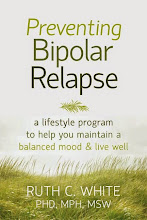
Preventing Bipolar Relapse: A Lifestyle Program to Help You Maintain a Balanced Mood and Live Well

Well....
All the writing about sleep, nutrition, exercise and interpersonal relationships has evolved into a program called SNAP (Sleep, Nutrition, Activity, People) and into a new book to be published in May by New Harbinger Press: Preventing Bipolar Relapse, that seeks to reduce the likelihood, frequency and intensity of bipolar episodes.

Click on the links below to order yours now:

Preventing Bipolar Relapse (New Harbinger Press)

Preventing Bipolar Relapse (Amazon)

From the publisher's website:

"If you buy just one book on bipolar disorder, let this be it.
There's an old saying: “Prevention is better than cure.” If you have bipolar disorder, this is especially true. For you, it's incredibly important to read the warning signs of a possible episode. For instance, you may find you are not sleeping as well as usual, or you might be sleeping too much. You may stop doing things that you normally enjoy, or you may start acting out your impulses in ways that alienate those around you or get you into trouble.
While the path to wellness for those with bipolar may involve psychiatric visits and medication adjustments, preventing manic and depressive episodes is the true key to staying healthy and happy. So how do you do it? And most importantly, how can you keep yourself motivated?
In this powerful, breakthrough book, bipolar expert Ruth C. White shares her own personal approach to relapse prevention using the innovative program SNAP (Sleep, Nutrition, Activity, and People). White also offers practical tips and tracking tools you can use anytime, anywhere. By making necessary lifestyle adjustments, you can maintain balanced moods, recognize the warning signs of an oncoming episode, and make the necessary changes to reduce or prevent it.
This is the first and only book on bipolar disorder that focuses exclusively on prevention. To help you stay well, White includes links to helpful online tracking tools so that you can manage your symptoms, anytime, anywhere. If you are ready to stop living in fear of your next episode, this life-changing book can help you take charge of your diagnosis-and your life."
“Preventing Bipolar Relapse is an essential guide for the consumer and caregiver alike. White's SNAP approach gives the reader an easy method to successfully navigate the complexities of bipolar disorder. Her personal experience offers hope, encouragement, and the tools to prevent relapse.”
-Muffy Walker, MSN, MBA, founder and chairman of the board at the International Bipolar Foundation


Friday, August 16, 2013

Sleep: how it works, what it does, how to get it, and how REM sleep affects depression

In this insightful interview with Terry Gross from NPR's Fresh Air (August 15), sleep expert and neutoscientist, Penelope Lewis of the Sleep and Memory Lab at the University of Manchester in the UK, brings us the state-of-the art knowledge about how our brsins work when we are asleep, including memories, learning and how sleep impacts depression. She covers the dos and donts of getting a good night's sleep and presents it in easily accessible language. Really worth a listen if you have ever had trouble falling, and staying, asleep.

Click on the link below to hear the interview and read the highlights:
http://m.npr.org/programs/all/13/212276021


Wednesday, May 1, 2013

The Problem with how we treat Bipolar Disorder

From the New York Times Magazine by Linda Logan published April 26, 2013

Written by someone with bipolar disorder who had several hospitalizations she writes about what happens to the self in the treatment of bipolar disorder.

For the article click the link below:

The Problem with how we Treat Bipolar Disorder


Thursday, March 21, 2013

CALL ME CRAZY ~ A movie of 5 short films on mental illness

From a press release from Lifetime to be shown on April 20, 2013  at 8 pm and now available on Netflix for your at-home viewing.

Though I haven't seen it, the stories in one film would seem to be the first time one film covers a wide range of mental illness from a wide range of perspectives. So I thought it was worth the publicity and tentative endorsement.


ABOUT CALL ME CRAZY: A FIVE FILM
Lifetime 4/20 8pm

Written by Deirdre O'Connor (Five) and directed by Howard, Lucy follows the film's title character (Snow), a law student who finds herself amidst the horror of schizophrenia, landing her in an institution where, through the support of a new friend (Ritter), meds and her psychotherapist (Spencer), she begins her path to not only healing, but a promising future. Lucy also features Clint Howard (Fringe).

Grace, directed by Maguire and written by Howard J. Morris (Five), explores bipolar disorder through the experience of a teenage daughter (Hyland) whose mother (Leo) grapples with the condition. Also starring in Grace are Melissa Farman (Temple Grandin) and Aimee Teegarden (Friday Night Lights).

Allison weaves together comedy and family drama in a story about healing when its eldest daughter "Lucy" (Snow) returns home from inpatient treatment and spoils her sister "Allison's" (Vassilieva) unveiling of her new boyfriend to their parents (real-life wife and husband Smart and Richard Gilliland, Desperate Housewives). Allison, also featuring Ken Baumann (The Secret Life of an American Teenager), was written by Jan Oxenberg (Parenthood) and is directed by Dern.

Eddie, directed by Hunt and written by Stephan Godchaux (Five), delves into the world of depression as seen through the eyes of a comedian's wife (Thompson) as she grapples with understanding how her husband Eddie (Mitch Rouse, According to Jim), whom is so loved, can be so withdrawn and overcome with sadness. The short also stars Handler and features appearances by Dave Foley (The Kids in the Hall), Jay Chandrasekhar (Super Troopers), James Avery (The Closer) and Ross Mathews (Chelsea Lately).

In Maggie, penned by Erin Cressida Wilson (Secretary) and directed by Judd, a female veteran (Hudson) returns home from war to her son and father (Ernie Hudson), only to have her life shattered by the onset of posttraumatic stress disorder, through which her lawyer, "Lucy," helps her. Griffith also stars in Maggie.

Tuesday, February 19, 2013

Scientific Update: Exercise, Mood, and Bipolar Disorder


Exercise is well-known to influence both physical and mental health. The articles reviewed in this post are specific to the impact of exercise on mental health and the symptoms of bipolar disorder. These articles show that people living with bipolar disorder are more likely to be overweight and to have poor eating habits. The implications of these studies is that people living with bipolar disorder must develop good eating habits and a routing habit of physical activity.


Kilbourne, Amy M., Dana L. Rofey, John F. McCarthy, Edward P. Post, Deborah Welsh, and Frederic C. Blow. 2007. "Nutrition and exercise behavior among patients with bipolar disorder." Bipolar Disorders 9, no. 5: 443-452.


Objectives: There have been few comprehensive studies of nutrition and exercise behaviors among patients with bipolar disorder (BPD). Based on a national sample of patients receiving care in the Veterans Affairs (VA) health care system, we compared nutrition and exercise behaviors among individuals diagnosed with BPD, others diagnosed with schizophrenia, and others who did not receive diagnoses of serious mental illness (SMI). Methods: A cross-sectional study of patients who completed the VA's Large Health Survey of Veteran Enrollees section on health and nutrition in fiscal year (FY) 1999 and who either received a diagnosis of BPD (n = 2,032) or schizophrenia (n = 1,895), or were included in a random sample of non-SMI VA patients (n = 3,065). The groups were compared about nutrition and exercise behaviors Results: Patients with BPD were more likely to report poor exercise habits, including infrequent walking or strength exercises than those with no SMI. They were also more likely to self-report suboptimal eating behaviors, including having fewer than two daily meals. 


Piri, Mohsen, Shirin Zardoshtian, Shahrzad Khazaee, and Roghieh Piri. 2012. "The Effect of Eight Weeks of Aerobic Training on Reducing Mood Disorders, Depression And Mania in High School Students High School Boys." International Journal Of Academic Research In Business & Social Sciences 2, no. 1: 267-273.

Abstract: The aim of this study was to consider the effect of eight weeks of aerobic training on the reduction of mood disorders, depression and mania in boys' high school in Ilam-Iran. This was a quasi-experimental and field research taking the experimental and control groups into consideration. In this study, 60 students were randomly selected as the sample. In order to measure students' Depression and mania, multifaceted Minnesota questionnaire (MMPI-2) and depression and mania sub-scales were used. We applied both descriptive and inferential statistics using SPSS software for statistical analysis of data. The results showed that eight weeks of aerobic exercise had a significant effect on students` depressive disorders and mania. Eight weeks of aerobic exercise reduced depression and mania in experimental group of students. [Edited from the abstract written by the author]


Eriksson, Sebastian, and Gunvor Gard. 2011. "Physical exercise and depression." Physical Therapy Reviews 16, no. 4: 261-268.
Objectives: The objective was to review studies which used physical exercise as an intervention to treat major depression, focusing on methodology, mechanisms of action, types of physical exercise and treatment outcomes. Methods: A literature review from PsycInfo and PubMed databases from 2000-2010 using the key words 'major depression', 'exercise', 'outcome', 'physical activity' and 'aerobic training' as search terms. Results: Eight studies met the inclusion criteria. Seven of the eight studies showed significantly improved mood and reduced depression. Three studies measured an increase in aerobic capacity, two with correlated mood improvements. One showed a correlation between increased muscle strength and reduced feelings of depression. Conclusion: Physical exercise can be an effective treatment against depression. A mood enhancing effect of exercise was identified in the interventions regardless of the mechanism of action.  [Edited from the abstract from the author]